
- All
- Product Name
- Product Keyword
- Product Model
- Product Summary
- Product Description
- Multi Field Search
Views: 0 Author: Site Editor Publish Time: 2026-09-23 Origin: Site


In the fast-paced commercial food industry, packaging operations carry immense stakes for your business. Choosing the wrong vacuum pouch quickly leads to severe oxidation and rapid freezer burn. These avoidable failures destroy product shelf life and ruin your hard-earned brand reputation. Standard poly bags simply fail when storing sensitive products over long periods. Transitioning to professional high-barrier solutions demands a precise structural match. You must perfectly align bag materials, food characteristics, and your specific sealing equipment. Finding this delicate balance prevents costly spoilage and extends product freshness significantly. We designed this definitive framework to simplify your complex procurement process. You will learn exactly how to evaluate, shortlist, and buy the correct packaging for your exact needs. Following these critical steps ensures complete product integrity from the processing facility to the dining table. It also directly supports your operational scalability and fiercely protects your retail profit margins.
Standard polyethylene (PE) bags often seem like a bargain initially. However, they carry severe hidden costs for commercial food operations. PE allows continuous micro-oxygen penetration over time. This slow leak leads to rapid color degradation, nutrient loss, and premature spoilage. Retailers routinely reject discolored meats. Customers inevitably return spoiled goods. Ultimately, you suffer massive profit loss due to this invisible degradation.
To avoid this scenario, you must evaluate two non-negotiable performance metrics. First, you need to check the Oxygen Transmission Rate (OTR). This critical metric measures exactly how much oxygen passes through the plastic film over a 24-hour period. Second, you must verify the Water Vapor Transmission Rate (WVTR). This tracks moisture loss or gain through the packaging. Lower OTR and WVTR numbers indicate vastly superior protection for your perishable goods.
Implementing properly spec'd high barrier vacuum bags transforms your entire business model. They extend product shelf life from a few weeks to several months. This newfound longevity directly improves your distribution reach. You can safely ship products farther across the country or internationally. Furthermore, extending shelf life protects retail margins by drastically reducing costly markdown cycles.
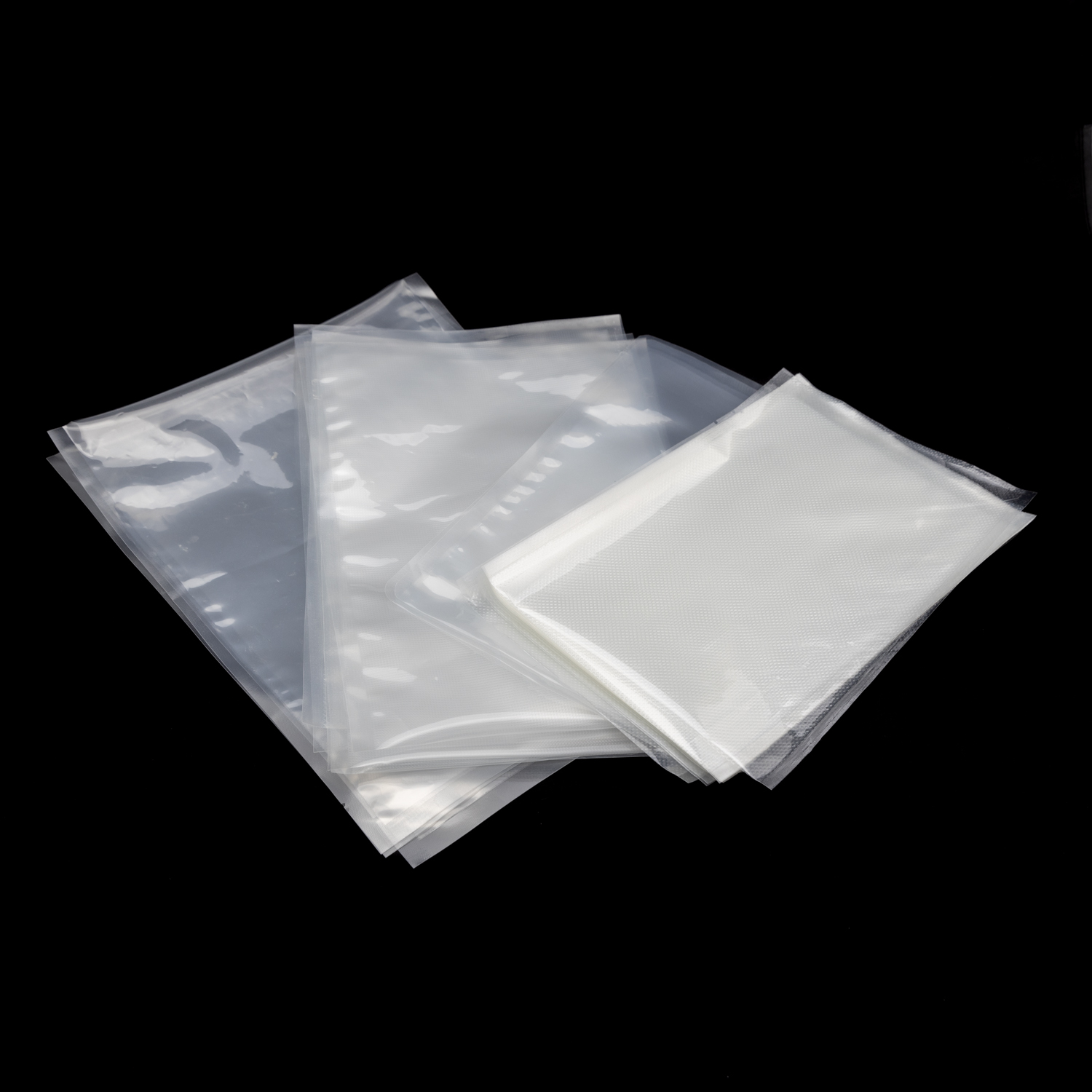
A harsh implementation reality faces many businesses during procurement. The most common error involves mismatching the bag texture to the vacuum sealer type. You must align these components perfectly to achieve a true, long-lasting vacuum seal.
Chamber machines operate by equalizing pressure inside a closed metal or acrylic box. They extract ambient air from the entire chamber, pulling it simultaneously from inside and outside the bag. Because the pressure remains perfectly equal, the bag mouth stays completely open until the heated seal bar clamps down. Therefore, these machines require standard smooth, flat barrier pouches. Smooth pouches cost significantly less to manufacture. They remain highly cost-effective and represent the absolute industry standard for high-volume, commercial operations.
External edge sealers operate quite differently. They pull air directly from the open end of the bag while the rest of the product sits outside the machine. If you use a smooth bag here, the plastic sides immediately stick together. This creates a seal prematurely and traps unwanted air inside the package. Therefore, you require an embossed barrier vacuum pouch. The textured channels act as microscopic tunnels. These tunnels allow air to escape seamlessly while the machine clamps down firmly on the plastic. They carry a higher cost per unit. Businesses typically use them in lower-volume, specialized retail, or R&D environments.
Evaluating packaging requires a deep understanding of material co-extrusions. You cannot rely on basic single-layer plastics to protect valuable food assets.
Nylon (PA) and Polyethylene (PE) form the foundational industry standard for flexible packaging. This specific combination provides excellent baseline performance. The PA outer layer offers crucial oxygen resistance and impressive puncture strength. Meanwhile, the PE inner layer acts as a reliable moisture barrier. It also ensures strong, hermetic heat sealing when clamped by the machine's thermal bar.
For extreme protection scenarios, advanced manufacturers integrate EVOH (Ethylene Vinyl Alcohol). Adding an EVOH layer provides unmatched oxygen blocking capabilities. You absolutely need this advanced polymer for highly sensitive items or long-term freezer storage. EVOH essentially creates an invisible, impermeable wall against atmospheric gases.
Thickness directly impacts physical durability and puncture rates. Let us break down the standard commercial options available to you.
Table: Vacuum Pouch Thickness Application Guide
| Thickness (Mil) | Durability Level | Ideal Food Applications | Puncture Resistance |
|---|---|---|---|
| 3-Mil | Standard Commercial | Smooth meats, soft cheeses, processed foods | Low to Moderate |
| 4-Mil | Heavy-Duty | Dried goods, jerky, slightly abrasive items | High |
| 5-Mil to 7-Mil | Extreme Industrial | Bone-in steaks, lobsters, bulk storage | Maximum |
Every single food product demands specific packaging attributes. You cannot adopt a one-size-fits-all approach. Let us explore how to match materials correctly to various distinct product categories.
Fresh red meat requires stringent oxygen control to maintain visual appeal. You should focus strictly on materials containing high EVOH barriers. EVOH prevents freezer burn and stabilizes the myoglobin protein. This preserves the bright red color consumers expect at the retail counter. Without EVOH, meats quickly turn an unappetizing brown, leading to immediate consumer rejection.
Sharp bone edges and crustacean shells will easily pierce standard plastics. You must emphasize high puncture resistance for these items. You face a distinct cost trade-off here. You can buy thicker 5-mil bags outright. Alternatively, you can apply thick, protective bone-guard wraps inside a cheaper 3-mil bag. Both methods work well. Choose the strategy based on your internal labor costs and production speed requirements.
Liquid packaging poses unique operational challenges. You must highlight the need for wide, highly secure seal seams. Weak seams inevitably cause disastrous blowouts during the intense chamber vacuum process. Ensure your machine uses a robust, double-wire seal bar to prevent catastrophic leaks during transit.
Cheese essentially lives and breathes throughout its lifecycle. You must carefully address the delicate balance of gas barriers. The packaging must absolutely prevent external mold growth. At the exact same time, it must maintain the required internal moisture levels. Certain aged cheeses even require specialized micro-perforated options to help off-gas excess carbon dioxide safely without ballooning the bag.
Procurement teams often struggle with correct bag sizing. You must calculate the optimal dimensions accurately to maintain operational efficiency and control costs.
Avoid the common trap of buying overly large pouches. They waste expensive material and inflate your operational costs unnecessarily. Conversely, too small bags lead directly to failed, wrinkled seals and high rejection rates. Follow a very simple rule of thumb. Always ensure at least 1.5 to 2 inches of empty headspace between the product and the seal bar. This guarantees a secure, wrinkle-free seal every single time.
Never ignore food regulatory requirements. Verify your shortlisted supplier provides proper, up-to-date documentation. You need verifiable proof of FDA, USDA, or CFIA compliance depending on your region. Confirm all materials are completely free of BPA, phthalates, and heavy metals. Trustworthy packaging manufacturers will gladly share these laboratory reports upon request.
You should follow a structured procurement path to minimize risk and ensure scalability.
Selecting the right packaging represents a strategic engineering decision. It is never just a simple commodity purchase. You must prioritize the three fundamental pillars of proper selection. First, guarantee complete machine compatibility. Second, match the material and thickness precisely to the food type. Third, aggressively verify the barrier performance through strict OTR and WVTR metrics.
Take decisive action today to protect your commercial products. We strongly encourage you to audit your current packaging fail rates immediately. Consult with a dedicated packaging specialist to identify supply chain vulnerabilities. Finally, request technical testing samples to validate performance on your own production line before signing long-term purchasing contracts.
A: High-barrier bags utilize specialized polymer layers like Nylon (PA) or EVOH. Unlike standard single-layer plastics, these co-extruded materials actively block oxygen and moisture transfer. This complex structure drastically reduces oxidation, prevents freezer burn, and extends the overall shelf life of sensitive perishable foods.
A: No. Smooth bags will immediately seal shut on external suction machines before the air is removed. External sealers strictly require an embossed bag. The textured micro-channels allow air to escape while the machine clamps down on the plastic.
A: Not necessarily. Thicker bags resist punctures much better, making them ideal for bone-in meats. However, they cost significantly more. They also require higher sealing temperatures and longer dwell times. You should always match the bag thickness to your actual product necessity rather than defaulting to the thickest option.
A: Most high-barrier PA/PE bags handle deep freezing exceptionally well. However, heat resistance varies greatly among manufacturers. You must specifically verify "boilable" or "sous-vide safe" ratings with your supplier. Do not assume all bags can safely withstand prolonged boiling temperatures without delaminating or leaching.


