
- All
- Product Name
- Product Keyword
- Product Model
- Product Summary
- Product Description
- Multi Field Search
Views: 0 Author: Site Editor Publish Time: 2026-10-10 Origin: Site


Retailer mandates, extended producer responsibility laws, and strict plastic regulations force food packagers to adapt quickly. Traditional PVC and PE wraps face imminent phase-outs across global supply chains. Finding a reliable, sustainable replacement remains a massive hurdle for operations managers today. You need a material maintaining crucial shelf life without demanding a complete, expensive overhaul of existing packaging machinery. Striking this balance dictates your future market viability. We offer an objective, evidence-based evaluation of PLA and PBAT blends in commercial packaging environments. You will discover the actual performance realities and distinct operational risks involved in this transition. We also examine how these innovative blends stack up against alternative biomaterials available on the market. By the end, you will know exactly how to integrate these solutions smoothly into your current production lines.
Packaging engineers face a unique challenge when moving away from traditional plastics. Polylactic Acid (PLA) offers excellent clarity and stiffness. However, PLA alone is far too brittle for wrapping applications. Polybutylene Adipate Terephthalate (PBAT) provides incredible flexibility and tear resistance. Yet, PBAT alone feels gummy and lacks retail-ready transparency. Blending these two polymers creates an ideal synergistic alloy. This specific formulation achieves the necessary balance of tensile strength, stretch, and stickiness required for commercial food applications.
Regulatory pressures now drive this material shift aggressively. Incoming bans on single-use plastics transform eco-friendly packaging from a niche luxury into a strict vendor baseline. Major grocery chains continuously publish aggressive sustainability targets. They demand compliance from every food supplier in their network. If you fail to adopt certified sustainable materials, you risk losing lucrative retail contracts entirely.
We must move beyond basic green marketing claims. This transition represents a functional reality for modern supply chains. Adopting bio-based blends secures your operations against future regulatory volatility. It stabilizes your packaging strategy as governments introduce stricter waste management protocols. You future-proof your product lines by switching proactively rather than reacting to sudden legislative bans.
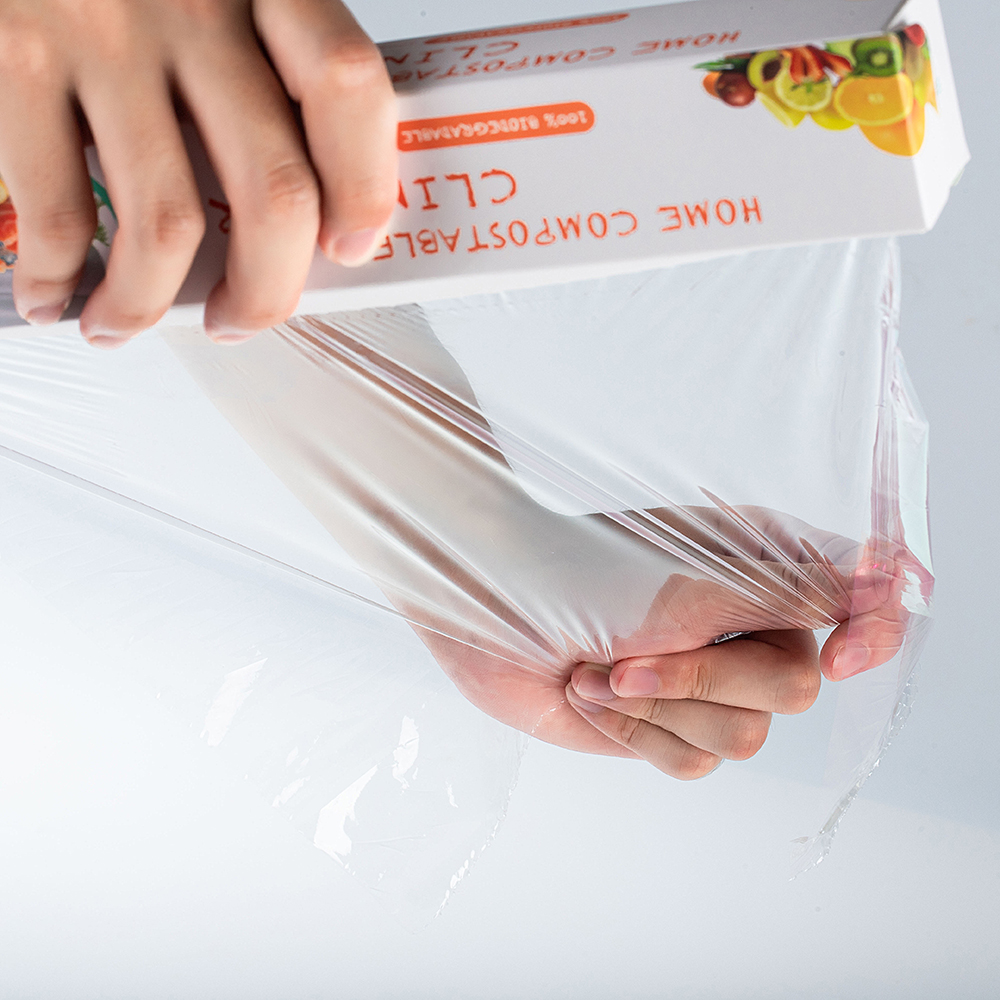
Evaluating elongation at break reveals how well bio-based films perform mechanically. Operators need films stretching smoothly around irregular shapes like meat trays and bumpy produce. Modern PLA/PBAT blends deliver exceptional stretch and memory retention. They snap back tightly against the packaged food without tearing prematurely. This mechanical behavior closely mirrors standard Polyethylene (PE) films utilized in existing facilities.
Historically, bio-based films struggled to achieve natural cling. Traditional plastics rely heavily on toxic plasticizers like phthalates for adhesion. Modern manufacturers solve this issue through advanced polymer formulation. They introduce safe, bio-based tackifiers during the extrusion process. This innovation ensures the film adheres securely to itself and the tray. You get a reliable, airtight seal protecting the contents.
Breathability directly impacts perishable food preservation. We analyze Oxygen Transmission Rate (OTR) and Water Vapor Transmission Rate (WVTR) rigorously. Respiring produce like broccoli and mushrooms requires specific permeability levels. A high-quality compostable cling film regulates this moisture transfer perfectly. It prevents internal condensation buildup while allowing harmless gas exchange. This exact permeability prevents bacterial growth and extends shelf life noticeably.
Visual presentation remains crucial in retail environments. Consumers inspect fresh food closely before purchasing. The PLA component ensures high transparency and surface gloss. Your products look fresh, clean, and appetizing under bright supermarket lighting. You do not have to sacrifice shelf appeal to achieve environmental compliance.
Operations managers must choose between several emerging biomaterials. We compare the three leading contenders currently dominating the sustainable packaging market.
Biomaterial Performance Comparison Chart
| Material Type | Primary Advantage | Notable Limitation | Retail Clarity |
|---|---|---|---|
| Starch-Based Films | Highly cost-effective | Poor moisture barrier | Low (Often cloudy) |
| PHA | Marine degradable | Production bottlenecks | Medium to High |
| PLA/PBAT Blend | Optimal flexibility | Needs strict storage | High |
Starch-based films offer excellent biodegradability and attractive pricing. Unfortunately, they suffer from severe moisture barrier deficiencies. They absorb ambient humidity rapidly and become prone to tearing on the production line. Furthermore, starch blends often look cloudy or yellowed. This poor optical clarity ruins retail food display requirements.
Polyhydroxyalkanoates (PHA) represent an exciting biological frontier. Microbes produce PHA naturally, making it highly marine degradable. It boasts excellent barrier properties against oxygen and moisture. However, PHA faces severe production bottlenecks globally. Yields remain low while extraction costs remain exorbitant. It currently lacks the cost-prohibitive pricing necessary for high-volume cling wrap applications.
The PLA and PBAT alloy holds the sweet spot for commercial readiness. It perfectly balances functional performance, global scalability, and economic feasibility. Manufacturers can produce these rolls consistently at scale. You receive a dependable product meeting stringent retail demands without facing the constant supply chain shortages associated with newer experimental polymers.
Understanding degradation certifications protects your brand from severe greenwashing allegations. Industrial compostable materials require high-heat facility degradation. Standards like BPI (in North America) and DIN CERTCO (in Europe) verify this process. The material must break down completely within commercial facilities maintaining specific temperature and microbial thresholds. Conversely, OK Compost Home certification indicates the film degrades in standard backyard compost bins. You must know exactly which certification your supplier holds.
Food contact safety remains non-negotiable. Certifications prove the degradation process leaves zero microplastics behind. The material must convert entirely into water, carbon dioxide, and biomass. Trusted suppliers provide documentation proving their films meet FDA and EFSA requirements for direct food contact. They rigorously test the material to guarantee zero toxic residues leach into fresh produce or meats.
On-pack communication dictates end-user behavior significantly. We recommend establishing clear labeling strategies to ensure consumers dispose of the film correctly. Below are essential labeling best practices:
Implementing these practices protects the packager from extended liability. Clear communication builds immediate consumer trust and fulfills extended producer responsibility obligations.
Machine compatibility dictates how quickly you can transition your lines. Operational managers worry about running bio-based films on existing automatic or semi-automatic wrapping equipment. When integrating PLA/PBAT food cling wrap into your setup, you usually need minor recalibrations. Bio-based plastics possess different melting points and elasticity profiles compared to standard PVC. You must adjust mechanical tension settings to prevent over-stretching. Additionally, lowering the heat-cutting blade temperatures prevents the polymer edges from melting unevenly during automated packaging runs.
Warehouse and storage conditions require strict oversight. Because engineers design this material to degrade, it possesses a finite intrinsic shelf life. The rolls themselves will break down prematurely if handled improperly. You must follow specific environmental protocols:
Shortlisting reliable suppliers minimizes production downtime. Do not purchase bulk orders blindly. Always ask manufacturers detailed operational questions upfront. Request comprehensive batch consistency data over the last twelve months. Demand verifiable certification documents matching your regional regulatory requirements. Finally, insist on receiving sample rolls for localized machine trials. Testing small batches on your specific equipment identifies tension issues before you commit to large-scale procurement.
PLA and PBAT food cling wrap is no longer an experimental laboratory concept. It stands as a commercially mature solution ready for high-volume deployment. Brands needing to exit traditional plastics can rely on this polymer blend to maintain food safety, visual appeal, and mechanical integrity. It satisfies strict retail mandates while securing supply chains against incoming regulatory bans.
We advise food packagers to begin adoption through a limited product-line trial. Utilize supplier samples to test machine compatibility rigorously. Monitor real-world shelf-life performance and consumer handling feedback closely. Once you optimize your equipment tension and cutting temperatures, you can scale procurement confidently across your entire packaging operation.
A: In industrial composting facilities, it typically breaks down within 90 to 180 days. This timeline depends heavily on specific certification standards like EN 13432. The combination of high heat, moisture, and active microbial environments accelerates the degradation process effectively.
A: Yes, it generally performs well in freezing temperatures. You can safely freeze wrapped meats and produce. However, prolonged high-heat microwave use requires caution. Bio-based plastics possess lower melting points compared to traditional PVC. Always test specific brand formulations before endorsing microwave applications.
A: Standard wrapping machines work perfectly fine in most cases. You do not need a complete equipment overhaul. Operators usually perform minor recalibrations. Adjusting film tension settings and slightly lowering cutting blade temperatures prevents the material from stretching excessively or melting prematurely.


