- All
- Product Name
- Product Keyword
- Product Model
- Product Summary
- Product Description
- Multi Field Search
Views: 0 Author: Site Editor Publish Time: 2026-11-06 Origin: Site
Meat packaging carries incredibly high stakes for modern processors, distributors, and retailers alike. Selecting a poorly matched packaging material immediately leads to elevated leaker rates, accelerated oxidation, and costly retail rejections. You need engineering precision to protect delicate product quality and preserve your operating margins.
Making this decision is never just a simple search for the best overall packaging material. You must carefully align specific meat characteristics—whether they are bone-in, boneless, fresh, or frozen—to exact technical film specifications. Metrics like oxygen transmission rate (OTR), moisture vapor transmission rate (MVTR), and puncture resistance define a film's actual performance. Ignoring these variables quickly compromises food safety and retail shelf appeal.
This article delivers a strict technical evaluation framework for procurement teams and packaging engineers. We will show you how to accurately shortlist the correct materials for your dedicated processing lines. You will learn how to navigate complex polymer choices, evaluate competing technical data sheets, and validate structural integrity through rigorous, real-world operational testing.
Application dictates material: Fresh red meat requires stringent oxygen barriers, while frozen products prioritize cold-crack resistance.
Puncture resistance is non-negotiable for bone-in cuts: High-abuse, cross-linked films are required to prevent micro-perforations during transit.
Material trade-offs exist: High-barrier options like a PVDC meat shrink film bag offer exceptional shelf-life extension but must be weighed against regional sustainability mandates and cost.
Validation requires line testing: Theoretical specs must be proven against real-world seal contamination (blood/fat) and existing vacuum chamber equipment.
Engineering teams must evaluate polymer films against strict performance metrics. Barrier Shrink Film requires careful scrutiny before entering any commercial production line. You cannot rely solely on basic thickness measurements. We need to analyze four critical evaluation pillars.
Gas and moisture regulation form the foundation of meat preservation. OTR measures the volume of oxygen gas passing through a square meter of film over 24 hours. You must define acceptable OTR thresholds to aggressively prevent aerobic bacterial growth. Fresh meats demand ultra-low OTR environments to halt spoilage. Conversely, MVTR measures water vapor escaping the package. Strict MVTR control prevents severe dehydration and subsequent freezer burn during prolonged cold storage.
Theoretical seal strength rarely mirrors actual production floor realities. Modern processing operates at high speeds. Sealant layers frequently encounter raw meat juices, liquid fat, and heavy blood residues. You must evaluate how the inner polymer layer performs under these highly contaminated conditions. Advanced ionomer resins often provide superior hot-tack strength. They aggressively bond through heavy liquid interference. Weak seals inevitably lead to catastrophic vacuum failure.
High shrink energy forces the film to conform tightly around irregular meat cuts. A premium shrink rate—typically between 30% and 50%—effectively acts as a second skin. This tight conformation dramatically reduces internal purge and messy drip loss. Buyers also demand high gloss and exceptional clarity. Superior optical properties ensure the meat retains its vivid color and looks highly appetizing under harsh retail lighting.
A film is only valuable if your existing equipment handles it efficiently. You must confirm material compatibility across automated vacuum packaging machines and rotary chamber systems. Stiff or overly thick films may jam sensitive equipment. Unmatched sealing temperatures easily melt or distort the packaging. Proper machinability ensures smooth production cycles without requiring complex or costly equipment retrofits.
Baseline Packaging Metrics Reference
Evaluation Metric | Standard Target Range | Primary Protective Function |
|---|---|---|
OTR (Oxygen Transmission) | < 15 cc/m²/24hrs | Inhibits aerobic bacteria and slows lipid oxidation |
MVTR (Moisture Vapor) | < 5 g/m²/24hrs | Prevents dehydration and severe freezer burn |
Shrink Percentage | 35% - 45% (at 85°C) | Reduces drip loss and improves aesthetic appeal |
Seal Contamination Resistance | High (Ionomer-based) | Ensures hermetic seals despite blood/fat interference |
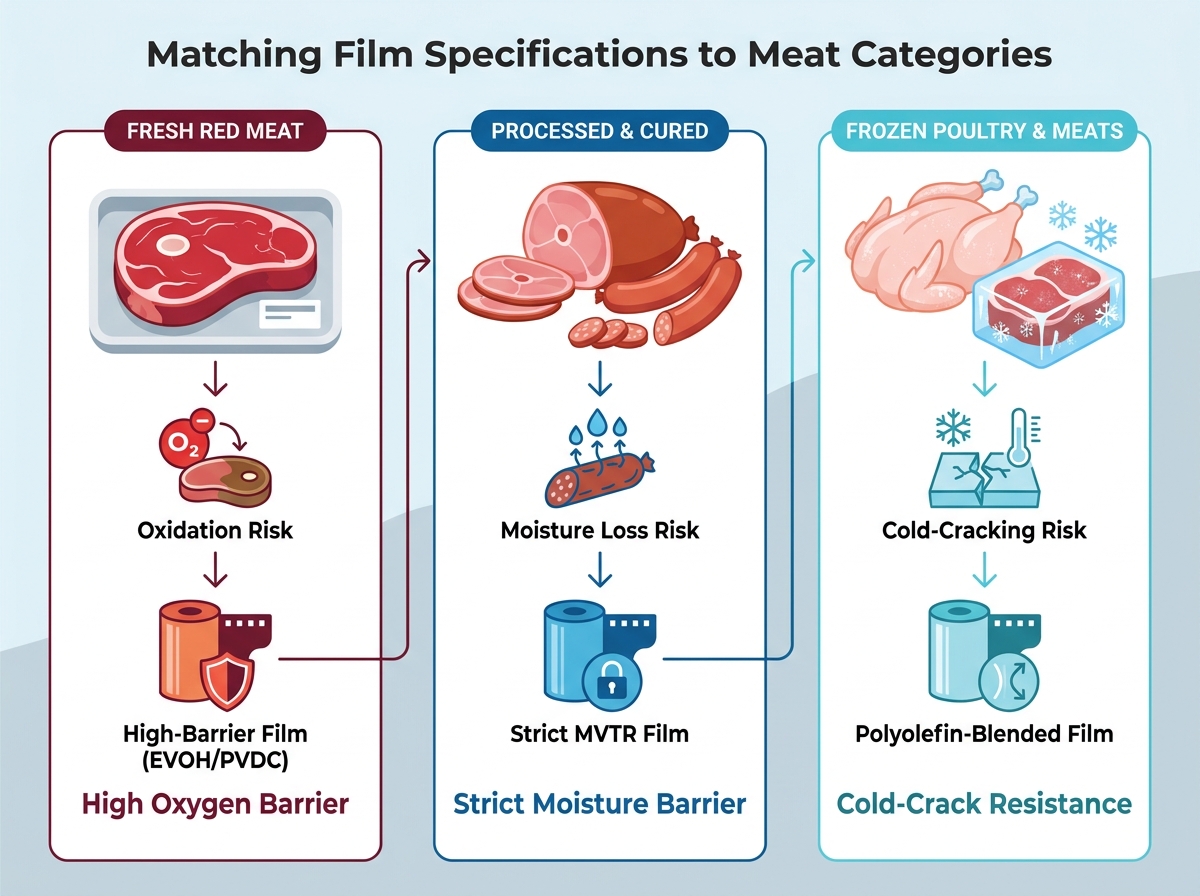
Different proteins react uniquely to environmental exposure. A universal film approach simply does not work for complex processing operations. You must pair the chemical properties of the meat directly to the molecular structure of the packaging.
Fresh red meats face one dominant primary risk: accelerated oxidation. Oxygen exposure rapidly degrades myoglobin molecules. This degradation turns vibrant red meat into an unappetizing brown shade. Spoilage organisms also multiply rapidly in oxygen-rich environments. The required solution involves utilizing high-barrier films containing EVOH or PVDC. These advanced polymers create an ultra-low OTR environment. This robust barrier maintains crucial myoglobin stability and successfully extends refrigerated shelf life for weeks.
Cured and smoked products undergo expensive flavor-enhancing processes. Their primary risk involves severe moisture loss, flavor degradation, and ugly UV light discoloration. Deli meats and sausages easily lose their distinct aromatic profiles if improperly sealed. You must implement medium-to-high barrier films focused heavily on strict MVTR control. This specialized approach permanently locks in initial weight yields. It tightly seals complex flavor profiles inside the package.
Freezing fundamentally changes packaging requirements. The primary risks shift entirely to massive freezer burn and sudden cold-cracking during rough transport. Ultra-high oxygen barriers matter much less when meat remains frozen solid. Instead, the optimal solution requires polyolefin-blended barrier shrink films. These highly durable polymers prioritize flexibility at sub-zero temperatures. They absorb heavy transport shocks seamlessly, preventing structural fractures over long supply chains.
Common Mistake: Using expensive high-barrier EVOH films for strictly frozen poultry. It needlessly inflates packaging budgets without adding measurable preservation value.
Best Practice: Always request low-temperature flex testing data before approving films intended for blast-freezing operations.
Handling heavy, bone-in products demands aggressive physical protection. Standard packaging materials fail instantly when pressed against sharp bone edges or rough cartilage. You need engineered resilience to survive distribution.
Micro-perforations are tiny, nearly invisible tears in the packaging structure. They silently destroy the internal vacuum environment. Oxygen floods into the package, triggering rapid bacterial bloom. These tiny punctures directly lead to immediate product spoilage and aggressive retailer chargebacks. The financial damage goes far beyond the discarded meat. Repeated leaker issues permanently severely damage your brand reputation among major supermarket buyers.
Engineers solve puncture issues through electron-beam cross-linking. This advanced manufacturing process bombards the polymer with high-energy electrons. It chemically alters the internal molecular structure, linking independent polymer chains together into a unified web. This structural transformation provides massively superior tensile strength. Cross-linked bags stretch significantly before breaking, making them incredibly resistant to sudden sharp impacts.
Extreme cuts require supplemental defense mechanisms. Standard cross-linked bags sometimes need extra help against aggressive protruding edges. Processors must choose between built-in patch bags and external bone guards. Patch bags feature heavily reinforced internal layers welded directly onto the primary film. They offer excellent operational speed. Alternatively, operators apply external wax-coated bone guards manually. You reserve these thick external guards for exceptionally difficult items like Tomahawk steaks and massive bone-in hams.
Polymer selection often determines the absolute limits of your geographical distribution radius. Knowing precisely when to deploy ultra-high-performance resins protects your most valuable protein assets across extended timelines.
Polyvinylidene chloride (PVDC) maintains an unshakeable reputation as a premium barrier material. A PVDC meat shrink film bag serves as an absolute gold standard for extreme preservation needs. Unlike other polymers, PVDC repels both oxygen and moisture simultaneously. It remains highly stable even in wet, high-humidity processing environments. It also provides outstanding resistance to flavor scalping, keeping distinct meat aromas securely contained.
You specify this robust material when failure is absolutely not an option. PVDC excels during the long-distance export of premium fresh meats across international borders. Sea freight requires months of stable refrigeration. Furthermore, extended-aging beef programs rely heavily on PVDC. The meat must age safely in a strictly controlled anaerobic environment for up to 60 days to maximize tenderness and flavor development.
Despite its formidable technical prowess, PVDC carries specific strategic trade-offs. Buyers must objectively address shifting environmental and regulatory compliance realities. PVDC contains chlorine, which frequently complicates local recycling streams and incineration protocols. Competing EVOH alternatives offer a cleaner environmental profile. However, EVOH aggressively loses its oxygen-blocking ability when exposed to high moisture. You must objectively weigh regional sustainability mandates against the mandatory shelf-life demands of your premium meat products.
Transitioning to a new packaging material requires rigorous, evidence-based validation. Never purchase bulk inventory based entirely on marketing brochures. You need a systematic implementation framework.
The evaluation begins strictly on paper. Demand a comprehensive Technical Data Sheet from every prospective supplier. You must closely scrutinize specific performance metrics. Verify the overall gauge (thickness) and layer structure. Check the stated OTR and MVTR against your baseline requirements. Critically, examine the exact shrink percentage measured at specific processing water temperatures, usually around 85°C (185°F). Inconsistent shrink profiles indicate poor manufacturing control.
Once the paper metrics align, you must execute a physical line trial. Roll out the sample material on your active equipment. Follow a structured testing procedure to verify operational compatibility.
Test Seal Bar Temperatures: Incrementally adjust your heating elements. Find the precise temperature window where the film seals securely without burning or melting.
Analyze Shrink Tunnel Performance: Run sealed packages through your hot water tunnel. Observe the shrink speed and look closely for any dog-ears or unsightly wrinkles.
Challenge Seal Strength: Intentionally contaminate the sealing area with liquid fat and blood. Run the vacuum cycle and verify the hot-tack strength holds firmly.
Measure Cycle Times: Ensure the new film does not slow down your automated rotary chambers. Slower cycle times ruin daily production efficiency.
Immediate sealing success does not guarantee long-term shelf stability. You must recommend and oversee a controlled shelf-life study. Store the newly packaged meat in standard commercial refrigeration for a full 30-day audit. Track leaker rates meticulously over this period. Measure any visible purge reduction compared to your legacy packaging. Finally, document red color retention daily. Only commit to a full commercial rollout after the audit proves complete success.
Packaging functions primarily as an active protective asset, never just a simple line-item expense. Attempting to cut budgets blindly on polymer films invites disaster. The cheapest film inevitably leads to massive financial losses through rapid product spoilage, heavy retailer chargebacks, and permanent brand damage.
You must approach procurement as a highly technical matching process. Before calling suppliers, sit down and map your exact product portfolio. Delineate clearly between your fresh and frozen lines, and separate your abrasive bone-in cuts from delicate boneless items. Once you define these operational variables, you can confidently request appropriate sample rolls for rigorous physical testing.
Follow these final action-oriented steps:
Audit your current leaker rates to identify specific machinery or material weak points.
Request updated Technical Data Sheets from your existing suppliers to establish a comparative baseline.
Schedule controlled line trials for any new cross-linked or high-barrier material under consideration.
Monitor your regional regulatory landscape regarding polymer compliance to stay ahead of sustainability mandates.
A: The ideal thickness varies significantly by application. Boneless retail cuts typically perform perfectly using 40-50 micron films. Conversely, heavy bone-in cuts and abrasive items strictly require 70-90+ microns or specialized reinforced patch bags to survive rough transport.
A: By heavily restricting external oxygen exposure and maintaining a tight internal vacuum, high-barrier films dramatically alter degradation rates. They effectively extend fresh beef shelf life from a mere few days up to 30+ days under proper commercial refrigeration.
A: Generally yes, you can run them on standard equipment. However, you will likely need to recalibrate seal bar temperatures and shrink tunnel water/air settings. Adjustments depend entirely on the specific polymer blend and the overall gauge of the new film.
A: Both function as excellent oxygen barriers. EVOH is frequently preferred for its much cleaner environmental recycling profile. PVDC, however, offers vastly superior moisture barrier properties and maintains strong structural integrity even in highly humid, wet processing environments.