
- All
- Product Name
- Product Keyword
- Product Model
- Product Summary
- Product Description
- Multi Field Search
Views: 0 Author: Site Editor Publish Time: 2026-06-11 Origin: Site


Rising labor costs constantly reshape the modern packaging landscape. Strict compliance standards push operations to modernize their equipment. Facility managers can no longer rely on isolated, semi-automatic workflows. High-volume facilities face a difficult balancing act. They struggle to maintain rapid throughput speeds while ensuring perfect packaging integrity. Manual interventions often create severe bottlenecks. Furthermore, high material waste quickly destroys tight profit margins.
This guide strips away marketing noise. We evaluate proven, high-ROI strategies for automated shrink wrapping systems in 2026. You need precise equipment to handle modern demands. We provide a technical framework to match machine capabilities directly to your production needs. You will learn how to choose between L-bar and side sealers. We also cover crucial material compatibility requirements to keep your lines running smoothly.
Primary Driver: The shift to automation is now dictated by total lifecycle operating costs and spare parts availability, not just initial CAPEX.
Throughput Benchmarks: Fully automatic systems are financially viable when daily output exceeds 750+ units, easily handling 30–40 packs per minute (up to 20,000/day).
Material Alignment: High-speed automation requires crosslinked polyolefin (POF) films; standard films risk snapping under machine tension.
Equipment Specialization: L-bar sealers dominate standard shapes (projected 41.8% market share by 2026), while side sealers are mandatory for infinite-length industrial products.
Facility managers are rapidly transitioning from isolated standalone machines to fully integrated packaging infrastructure. Industry data projects the global shrink wrapping market will scale toward $1.3 billion by 2036. Manufacturing and warehousing sectors currently hold a dominant 56.3% share. This growth reflects a permanent shift in how modern factories operate. Packaging is no longer an afterthought. It serves as a vital component of automated logistics.
A severe technical labor shortage actively limits production capacity across all sectors. Operators command higher wages, making manual packaging financially unsustainable. Fully automated systems fundamentally alter the operator's daily role. These machines reduce human involvement to simple loading and unloading tasks. When you integrate conveyors properly, staff transition into oversee-only roles. They monitor the line rather than manually sealing individual packages. This shift eliminates repetitive strain injuries and boosts overall output consistency.
Modern packaging lines demand high uptime. By 2026, Internet of Things (IoT) connectivity has become a baseline standard. Modern systems utilize integrated sensors to monitor critical components in real time. They track seal wire degradation before failure occurs. They also monitor shrink tunnel temperature fluctuations, which typically operate between 120°C and 200°C. Predictive maintenance alerts you to replace parts during scheduled shifts. This prevents unplanned downtime and saves thousands of dollars in lost production.
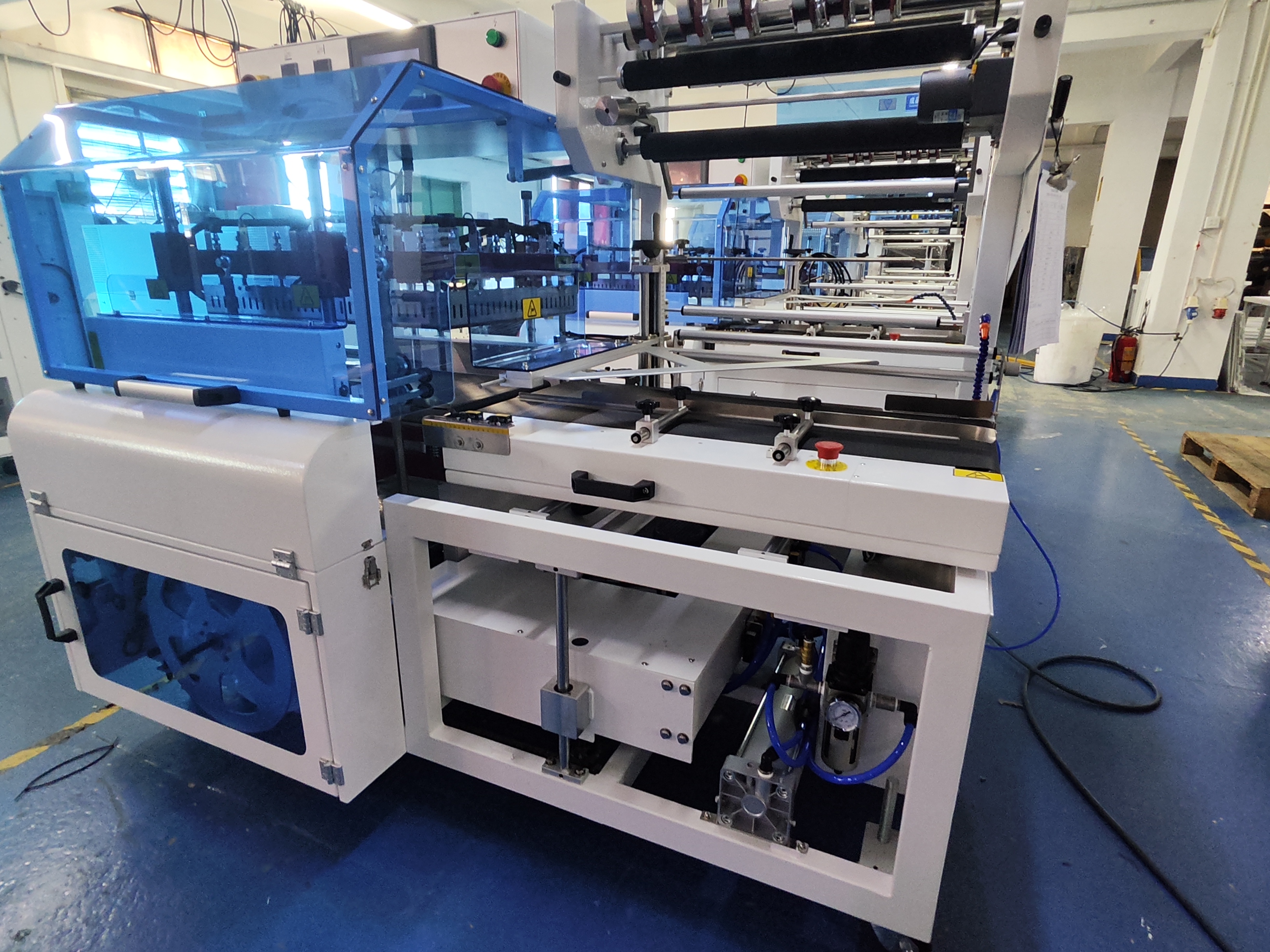
Different industries require highly specialized equipment configurations. You must match the machine design to your specific product environment.
Food manufacturing demands exceptional hygiene and visual appeal. food shrink wrapping dominates this sector. It historically comprises over 37% of the total market share.
Use Case: Facilities use these systems for tamper-evident sealing and multi-pack bundling. Bulls-eye packaging easily groups water bottles or canned goods. The tight seal also significantly extends shelf life by reducing oxygen exposure.
Technical Requirement: You must strictly use FDA-approved POF films. The machine requires precision pinwheel perforators. These tiny spiked wheels puncture microscopic holes in the film. The holes allow trapped air to escape during heating without compromising the sterile barrier.
Construction materials present unique sizing challenges. Heavy-duty industrial shrink packaging systems handle extreme weights and unusual dimensions.
Use Case: Facilities process infinite-length products. Common examples include wood moldings, PVC piping, and metal extrusions.
Technical Requirement: You cannot use standard L-bar sealers for these items. The jaw length physically restricts the product size. These operations require continuous motion automatic side sealers. Side sealers apply a seal continuously along the product's edge, accommodating literally any length.
High-value goods require absolute protection against tampering and environmental damage.
Use Case: Pharmaceutical lines demand total closure packaging. This creates strict anti-counterfeiting measures and absolute moisture barriers.
Technical Requirement: These setups rely on flat sealing wires to create thicker, stronger seals. They pair these wires with magnetic hold mechanisms. The magnets clamp the sealing jaw shut with precise pressure. This guarantees zero seal failure during high-speed runs.
Avoid vague manufacturer claims about "high speed" capabilities. You need hard quantitative data to shortlist the right equipment. Proper sizing prevents capital waste and eliminates operational bottlenecks.
Use daily production volumes to determine your automation level. Compare your actual throughput against these proven benchmarks:
Daily Output Range | Recommended Machine Type | Operational Strategy |
|---|---|---|
Under 250 units | Manual I-bar / Semi-automatic desktop units | Low-volume operations. Requires manual film pulling and operator heat application. |
250 – 750 units | Semi-automatic L-bar sealers | Medium volume. Pair with standalone shrink tunnels. Operator feeds the product manually. |
Over 750 units (up to 20,000) | Fully Automatic Systems | High volume. Fully integrated conveyors handle spacing, sealing, and shrinking. |
When your facility consistently processes more than 750 units per day, you reach the definitive threshold for an automatic heat shrink wrapping machine. These machines justify their cost rapidly through massive labor reductions.
You must choose between two distinct sealing architectures. automatic shrink wrapping machine models often use L-bar designs. These units reliably hit 30–40 packs per minute. However, they possess strict dimensional constraints. The physical dimensions of the "L" jaw dictate the maximum product size. If a box is wider or longer than the jaw, the machine cannot seal it.
Conversely, continuous side sealers remove length restrictions entirely. They seal the side of the film as the product moves forward. This flexibility is brilliant for mixed-size batches. Yet, side sealers require highly precise conveyor timing. You must manage film tension carefully to prevent skewed seals.
Measure your largest product variant before consulting suppliers.
Account for seasonal volume spikes. Buy 20% more capacity than your current daily average.
Your hardware only performs as well as the plastic running through it. Automated systems exert massive mechanical stress on packaging films. Selecting the correct polymer is critical for continuous operation.
Standard polyolefin (POF) film lacks the structural integrity for automated dispensers. Automated heads pull film at violent speeds. Standard films often stretch, warp, or snap under this extreme tension. When a film snaps, the entire production line stops. Operators must re-thread the machine, wasting valuable time.
You must use crosslinked POF. Manufacturers treat crosslinked films with radiation to bond the polymer chains tightly together. This process massively increases tensile strength. Crosslinked POF is absolutely non-negotiable for automatic systems. It prevents tearing and withstands rapid cycle times flawlessly.
Modern facilities actively phase out Polyvinyl Chloride (PVC) films. PVC poses severe regulatory risks. It also threatens equipment longevity. Exposing PVC to extreme tunnel heat releases trace hydrogen chloride (HCl) gas. Over time, this gas accelerates equipment corrosion. It destroys carbon steel components and ventilation ducts. Furthermore, it violates modern facility safety standards and compromises operator health.
Different heat shrink packaging applications require distinct heating elements. You must match the wire to the film.
Flat Wires: These create wider, stronger seals. They handle heavy, dense products perfectly. The broad contact area melts more plastic, ensuring the seam holds during rough transit.
Round Micro-Knives / Band Ribbons: These elements offer lightweight speed. They simultaneously seal the edge and cut away excess film. A POF shrink film machine often utilizes micro-knives to achieve 40-pack-per-minute speeds without leaving jagged plastic edges.
Purchasing automation carries inherent physical risks. Smart buyers look past marketing brochures. They focus on defect mitigation, parts availability, and physical integration.
A common packaging defect is "angel hair." These are fine, web-like plastic threads dangling from the seal seam. They ruin the retail presentation. Angel hair occurs due to uneven heat distribution across the sealing jaw. It also happens when operators apply Teflon tape incorrectly. The plastic stretches into strings rather than cutting cleanly. Evaluate machines based strictly on their temperature control consistency. Solid-state temperature controllers prevent the micro-fluctuations that cause angel hair.
Do not base your decision solely on the initial sticker price. Look at the ongoing operational reality. The actual value of an automated wrapper relies entirely on spare parts availability. You will routinely replace sealing wires, Teflon tape, and conveyor belts. If your supplier lacks local inventory, you will suffer catastrophic downtime. Prioritize brands boasting robust local technician networks. Fast response times keep your lines moving.
Automatic systems require massive footprint planning. You cannot simply drop them onto an existing floor. Conveyor speeds present another challenge. The infeed conveyor must space products perfectly before the sealing jaw. Furthermore, the tunnel conveyor speed must precisely match the shrink tunnel's thermal capacity. If the belt moves too slowly, the film burns. If it moves too quickly, the plastic fails to cure and shrink fully. Map your floor plan carefully.
Ignoring factory ambient temperature. Cold factories require higher tunnel settings.
Failing to provide dedicated power drops. Shrink tunnels draw massive amperage and require isolated circuits.
Buying an automated system is fundamentally an exercise in constraint matching. You must align your daily production volume strictly to the correct machine type. Let your product dimensions dictate whether you buy an L-bar or a continuous side sealer. Do not attempt to force large industrial goods through an undersized L-bar jaw.
Before finalizing any procurement, demand a live film-run test. Send your specific products and your chosen crosslinked POF film to the manufacturer. Have them record a continuous 15-minute run. This test verifies real-world seal integrity. It confirms tunnel temperature compatibility. It reveals exactly how the machine handles your specific materials. Following this precise technical framework guarantees a high-ROI implementation in 2026.
A: The maximum length and width are strictly bound by the physical dimensions of the "L" sealing jaw. For excessively long products, a side sealer must be used instead.
A: High-speed film dispensers apply immense mechanical tension. Crosslinked POF has higher tensile strength, preventing the film from snapping during continuous 40-pack-per-minute cycles.
A: This defect occurs when sealing wires are at the wrong temperature, worn out, or lack proper Teflon tape coating, causing the plastic to stretch into fine threads rather than cutting cleanly.
A: No. Shrink wrappers typically apply full-enclosure thin films (POF) for display and protection. Bundlers (poly bundlers) use thicker polyethylene (PE) to group heavy items (like water bottles), leaving open "bulls-eyes" at the ends.


