- All
- Product Name
- Product Keyword
- Product Model
- Product Summary
- Product Description
- Multi Field Search
Views: 0 Author: Site Editor Publish Time: 2026-11-13 Origin: Site
Meat processors and retailers face intense dual pressures today. You must maximize shelf life to reduce spoilage while keeping cuts looking premium in the retail case. Shoppers demand vibrant, fresh-looking meat. Any discoloration quickly kills a potential sale. For decades, conventional overwrap served as the standard packaging choice. However, modern supply chains now span much longer distances. Tight retail margins force processors to rethink old packaging habits. Weak seals and constant oxygen exposure lead to massive profit leaks through premature food waste. This guide provides a technical evaluation framework for assessing your packaging options. We will explore the mechanics behind these packaging materials. You will discover how they directly impact shelf life, leak rates, and visual appeal. Ultimately, you will learn exactly when upgrading to Barrier Display Shrink Film justifies the operational shift.
Barrier display shrink film actively extends shelf life by controlling oxygen transmission (OTR), whereas conventional overwrap relies on permeability to maintain short-term meat color.
Upgrading to barrier films drastically reduces "purge" (liquid loss) and package leaks, directly impacting retail profitability and brand perception.
Transitioning requires evaluating existing equipment compatibility, as barrier shrink formats typically necessitate vacuum sealers and shrink tunnels.
Fresh meat represents a high-value, highly perishable grocery category. When your packaging fails to protect the product, you lose money fast. Let us break down exactly where these operational profit leaks happen in the real world.
Premature oxidation destroys your bottom line. Retail shrink happens when meat loses its visual appeal before a customer buys it. Constant oxygen exposure causes the myoglobin proteins in the meat to oxidize rapidly. They turn the flesh an unappealing brown or gray color. Shoppers will always bypass brown meat in favor of bright red cuts. Retailers then must slash prices heavily or discard the product entirely. This food waste carries a massive financial penalty. You absorb the cost of the animal, the processing labor, and the transport, only to throw the final product away at the store level.
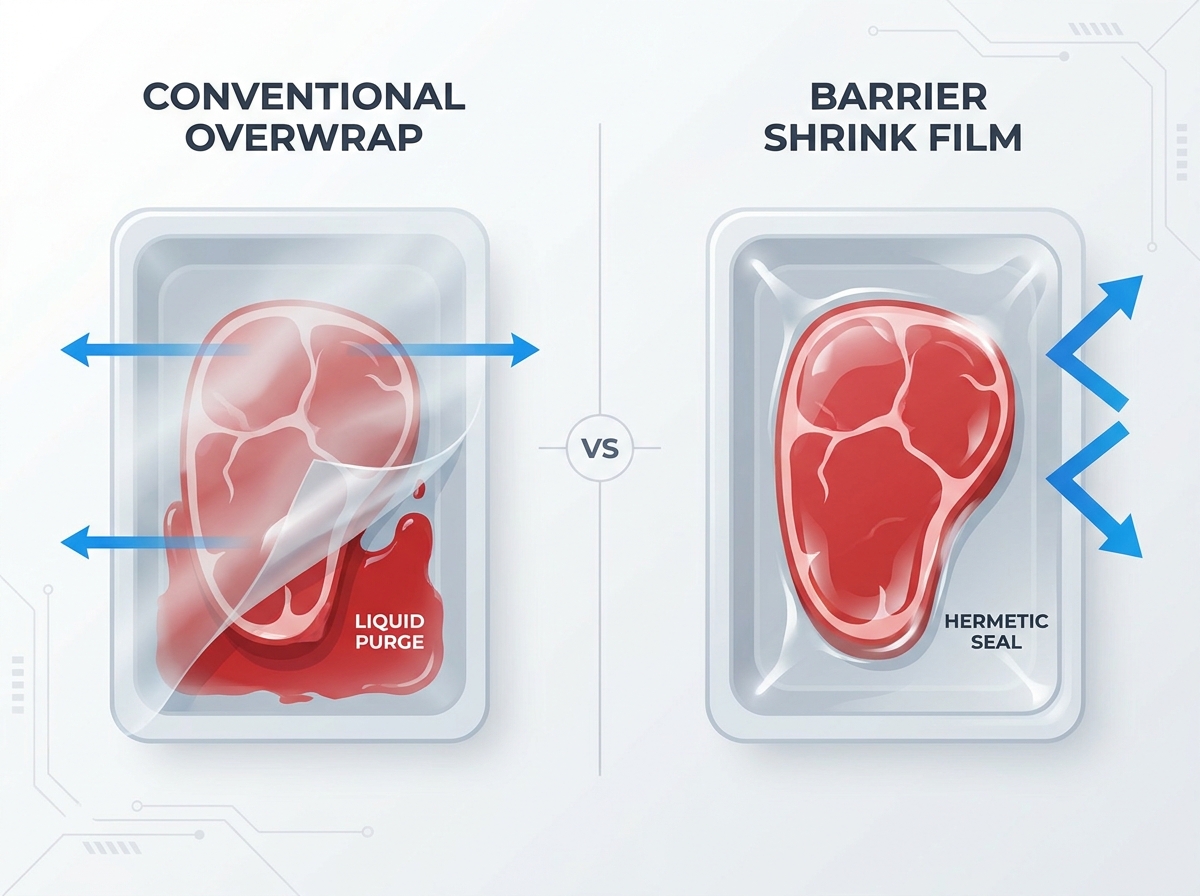
We define "purge" as the red liquid pooling at the bottom of a meat tray. Traditional packaging struggles to contain it. Purge damages product optics significantly. A pool of blood-like liquid repels consumers immediately. Beyond aesthetics, this liquid encourages rapid bacterial growth. It creates a perfect environment for spoilage organisms to thrive. Conventional films cannot hold this liquid tightly against the meat tissue. As a result, processors often use absorbent pads hidden under the meat. These pads look messy, add extra material costs, and degrade the premium feel of the cut.
Industry trends heavily favor centralized case-ready processing models. Facilities cut and package meat at a central hub before shipping it to retail stores. This model requires highly durable packaging. Your packages must survive longer transit times. They endure constant vibration, temperature fluctuations, and rough manual handling. Conventional overwrap easily tears or loses its seal during transport. Centralized processing needs a robust packaging solution. You cannot compromise structural integrity or food safety during these cross-country journeys.
To solve these ongoing supply chain problems, we must understand how different packaging materials actually work. The science behind the plastic dictates its performance in the real world.
Grocery stores have used Polyvinyl Chloride (PVC) and Polyethylene (PE) overwrap for decades. You see this packaging in almost every local butcher shop.
Mechanism: This material is highly oxygen-permeable. It allows ambient oxygen to flow freely into the package. This oxygen exposure allows fresh beef to "bloom" naturally. The meat quickly turns a bright, cherry-red color that shoppers recognize.
Limitation: Blooming looks great initially, but it has a severe downside. Overwrap does not provide an atmospheric barrier. Once the bloom phase peaks, spoilage accelerates rapidly. Oxygen fuels the aerobic bacteria growing on the meat surface. You essentially trade long-term preservation for a short-term color boost.
Modern meat processors increasingly rely on advanced material science. A barrier display film operates on entirely different principles.
Mechanism: Manufacturers create these films using multi-layer co-extrusion technology. They combine different polymers, often including EVOH (Ethylene Vinyl Alcohol) or PVDC (Polyvinylidene Chloride). These specific core layers actively block oxygen and moisture from passing through the plastic.
Shrink Dynamics: The packaging process involves a specific sequence of physical changes:
The packaging machine vacuums all ambient air out of the package.
A heated seal bar hermetically fuses the open end together.
The package passes through a hot water or hot air shrink tunnel.
Heat causes the polymer chains in the film to contract.
The film shrinks tightly around the product, acting as a protective "second skin."
Outcome: By blocking new oxygen and removing trapped air, you suspend the natural degradation process. You lock in freshness safely. This mechanism significantly extends the safe display window for the retailer.
Choosing the right packaging requires a highly structured evaluation. You must weigh several critical performance metrics to match your specific operational goals.
Shelf life directly dictates your geographic reach and retail flexibility. You must control oxygen to gain time.
Conventional overwrap typically offers 3 to 5 days of shelf life for fresh cuts. This short window forces retailers into a frantic race against the clock. If the meat does not sell quickly, it becomes total waste.
In contrast, barrier films change the timeline entirely. Depending on the meat type and vacuum process, shelf life often extends to 14 to 21 days or more.
Oxygen Transmission Rate (OTR) drives this massive difference. OTR measures how much oxygen passes through the film over 24 hours. High OTR leads to rapid lipid oxidation. Lipid oxidation causes rancidity and foul off-odors. By utilizing a film boasting a near-zero OTR, you stop lipid oxidation in its tracks.
Consumers buy food with their eyes first. Packaging optics can make or break a premium meat brand.
Traditional PVC films are highly prone to wrinkling. They often suffer from fogging when store display temperatures fluctuate. They also allow liquid pooling in the tray. A foggy, wrinkled package holding pooled liquid looks cheap and unappetizing.
Advanced barrier films deliver high gloss and exceptional visual clarity. The heat shrink process creates a tight, premium 3D contour around the specific cut of meat. It looks custom-tailored to the product. Furthermore, the tight shrink eliminates fogging entirely. It holds natural juices inside the meat tissue, effectively hiding and preventing purge.
A leaking package creates a serious biohazard in the grocery aisle. It ruins the customer experience instantly and requires immediate cleanup.
You must assess puncture resistance, especially when packaging bone-in cuts like ribeyes or thick pork chops. Conventional overwrap punctures very easily. Sharp bone fragments can slice right through it during standard transit.
Additionally, conventional overwrap relies on weak heat seals. The film merely tacks together at the bottom of the tray. Barrier shrink films use hermetic, cross-linked seals. The vacuum sealer fuses the plastic layers together permanently. This hermetic seal drastically reduces cross-contamination risks in retail environments. It keeps dangerous pathogens out and meat juices safely in.
Packaging Performance Summary Chart
Performance Metric | Conventional Overwrap | Barrier Display Shrink Film |
|---|---|---|
Oxygen Transmission (OTR) | High (Highly Permeable) | Near-Zero (Strong Barrier) |
Average Shelf Life | 3 - 5 Days | 14 - 21+ Days |
Seal Integrity | Weak Tack Seal | Hermetic Heat Seal |
Visual Optics | Prone to fogging and wrinkling | High gloss, 3D contour, crystal clear |
Puncture Resistance | Low (Tears easily) | High (Resists bone punctures) |
Upgrading your packaging material means upgrading your entire operational process. You cannot simply swap rolls of film and expect different results. You must prepare your facility for the technical transition.
Moving to a high-barrier format requires capital expenditure. If your facility currently uses simple stretch wrappers, you will need new equipment. Barrier films require heavy-duty vacuum packaging machines to remove the ambient air. You also need hot water or hot air shrink tunnels to activate the film's physical shrink properties. This machinery represents a significant upfront investment, but it modernizes your production floor capabilities.
You must evaluate how shrink packaging line speeds compare to automated overwrappers. High-speed overwrappers can process dozens of trays per minute easily. Vacuum sealing takes slightly longer. The machine must physically evacuate the air before sealing the plastic. However, modern rotary vacuum chambers and automated shrink tunnels have closed this speed gap. You can achieve high throughput, but you must design your line layout carefully to avoid bottlenecks.
Food safety remains your top operational priority. You must confirm that high-barrier multi-layer films meet stringent FDA food contact standards. Reputable manufacturers engineer these films specifically for direct food contact. They use approved polymers and safe extrusion methods.
The hermetic seals actively support HACCP (Hazard Analysis Critical Control Point) compliance protocols. By minimizing package leaks and preventing external contamination, you drastically reduce food handling risks throughout the entire supply chain.
Every new technology brings a learning curve. Address this operational friction early through comprehensive staff training. Your machine operators must learn to manage new variables.
Monitor vacuum levels constantly to avoid crushing delicate meat products or breaking trays.
Calibrate seal temperatures precisely for your specific film thickness.
Maintain clean seal bars daily to prevent weak spots in the hermetic seal.
Running the seal bar too hot, which burns the film and causes invisible micro-leaks.
Running the seal bar too cold, resulting in weak seals popping open during transit.
Setting the shrink tunnel temperature too high, which can partially cook the surface of the raw meat.
Selecting the right packaging dictates your operational success and retail relationships. It affects everything from basic food safety to consumer brand perception.
We recommend conventional overwrap only for highly specific scenarios. Use it strictly for back-of-store, daily cut-and-wrap operations. It works well when you have immediate local turnover and shoppers buy the meat on the same day it hits the shelf.
Conversely, we strongly recommend barrier shrink films for centralized case-ready processors. It serves as the clear choice for premium product lines. If your operation prioritizes shelf-life extension, waste reduction, and national distribution, you need a robust barrier solution.
Do not guess when making this operational transition. Advise your procurement and engineering teams to take these concrete action steps:
Conduct a thorough packaging line audit to identify equipment gaps.
Request physical film samples from trusted suppliers.
Run a pilot test in your specific facility using your actual meat cuts.
Measure your new leaker rates and carefully track the shelf-life gains.
Real-world data will confidently guide your final packaging decision.
A: Yes. It is FDA-approved and widely used for beef, pork, poultry, and lamb. However, operators must carefully adjust vacuum levels for delicate cuts to prevent crushing the meat or distorting the plastic tray.
A: Because it restricts oxygen, beef may exhibit a darker, purplish color called deoxymyoglobin while sealed. Consumers are becoming increasingly educated on this indicator of freshness. The meat will quickly "bloom" to a bright red once the package is opened.
A: No. Barrier display films require dedicated vacuum sealing and heat shrink equipment to activate their protective properties. This process differs entirely from the simple stretch-and-tack method used for traditional overwrap films.
A: Multi-layer barrier films are traditionally harder to recycle than single-stream plastics. However, their ability to drastically reduce food waste often results in a lower overall environmental footprint in lifecycle assessments. Food waste remains a massive global carbon contributor.